Introduction
Most FinTech services are online services which means that you do not have to go to the bank. As a result, it is crucial for service providers to develop their own identification mechanisms for data security. Recently, service providers in different domestic industries have developed their own identification mechanisms, which drive their development costs and are inconvenient to their customers. To balance between information security and customer experience, we have taken new technologies (such as: SIM card authentication and biometrics) into account, and may flexibly add other identification tools. On May 16, 2016, The Financial Supervisory Commission published the “The White Paper on the Development and Strategies of Financial Industry” which discussed the integration and establishment of an identification center for financial institutions. It also suggested the establishment of a trusted and professional third party to provide various identification tools and mechanisms to help service providers in different industries maximize their strengths and provide innovative FinTech services.
- Establishment of an identification center is one of the existing national policies (Financial Supervisory Commission/National Development Council)
- Promotion has continuously begun since the “FinTech Development Strategy White Paper” was published in 2016 (Financial Supervisory Commission)
- The Ministry of the Interior agreed with the interfacing of the identification service with citizen digital certificates (March, 2017)
- Cooperated with Taiwan Clearing House (TCH) to use certificates for agreed settlement accounts (May, 2017)
- Contracts were concluded with the five Taiwanese telecoms operators to provide “Mobile ID Identification Service” (October, 2018)
- Cooperate with Chunghwa Post to provide the verification services for its accounts (September, 2019)
Development Blueprint and System Architecture
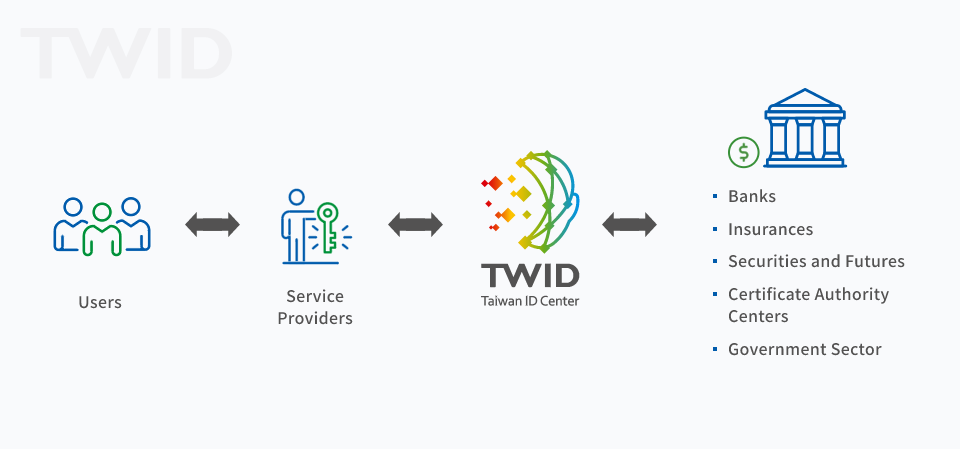
The identification service is key to online transactions. When we provide our complete identity information online, we can provide it to the right person. To meet the market needs and respond to the policy of Financial Supervisory Commission (FSC), TAIWAN-CA Inc. has employed the original PKI technology and its experience in information security in the securities, banking, insurance, and telecoms industries to develop the “Hybrid ID Technology Portfolio” consisting of four major services:
1. Multiple ID Mechanisms
The identification process mainly consists of two steps. One is the Authentication step to “check if your data provided is correct,” while the other one is the Identification step to identify “who you are” using the data provided by customers.
2. Credential Management
After the identification process is completed, we will provide a credential as a trusted tool between both parties (such as the certificate, account password). At the same time, three other things must be done properly: Enrollment, Credential Management, and Entity Authentication.
3. E-signature/Verification
During the transaction, a credential must be used to sign electronic documents and provide authentication, verification, and storage of documents.
3. Data Sharing
Service Provider A provides customer identification results or document receipts to Service Provider B. At this time, it should obtain authorization from customers and provide them to different service providers in a safe and trusted transmission method via the data transfer services by TWID.